CM Content Studio


Overview
Logline
A privileged city teen recovering from a stress-related illness is sent to spend the summer with her estranged grandmother on a Cherokee reservation, where a bitter divide over a development project, and the conflicting paths of the women in her family, challenge her to question the life she’s been groomed for.
Synopsis
Fifteen-year-old Genevieve Rivers has spent her life trying to become the daughter her mother wants her to be. The child of a world-famous concert pianist, she moves through an elite New York world of private schools, music lessons, and impossible expectations. When a stress-related illness leaves her too weak to accompany her mother on a European tour, Genevieve is sent to spend the summer with a grandmother she barely knows on a remote Cherokee reservation in the mountains of North Carolina—a place she has never wanted to visit and a family she hardly remembers.
Stillwater is in the midst of a crisis. A proposed resort development promises jobs and economic opportunity but threatens to transform Blackwing Mountain, a place many residents believe is inseparable from their identity and history. The controversy divides neighbors, friends, and families, drawing Genevieve into a conflict she does not understand. Through her grandmother Mae, a respected elder; Ash Walker, a quiet young horseman carrying responsibilities beyond his years; and a circle of new friends whose lives look nothing like her own, Genevieve begins to encounter a world shaped by community, tradition, and a profound relationship with the land.
As summer unfolds, the mountains begin to work on her in ways she cannot explain. What begins as homesickness and resistance slowly gives way to curiosity, wonder, and belonging. After becoming lost in the wilderness during a solitary walk, Genevieve experiences a transformative journey through the forests and ridges surrounding Stillwater. Guided by unexpected signs in nature and rescued by a community that refuses to give up on her, she returns changed—more confident, more grounded, and increasingly certain that the life waiting for her back in New York may not be the life she wants.
But as the battle over the development intensifies, Genevieve finds herself caught between opposing visions of the future. The town’s divisions fracture friendships, strain family bonds, and force everyone—including Genevieve—to confront difficult questions about progress, tradition, and sacrifice. When a hidden truth about the development comes to light, the community must decide not only what kind of future it wants, but what it owes to the land and to one another.
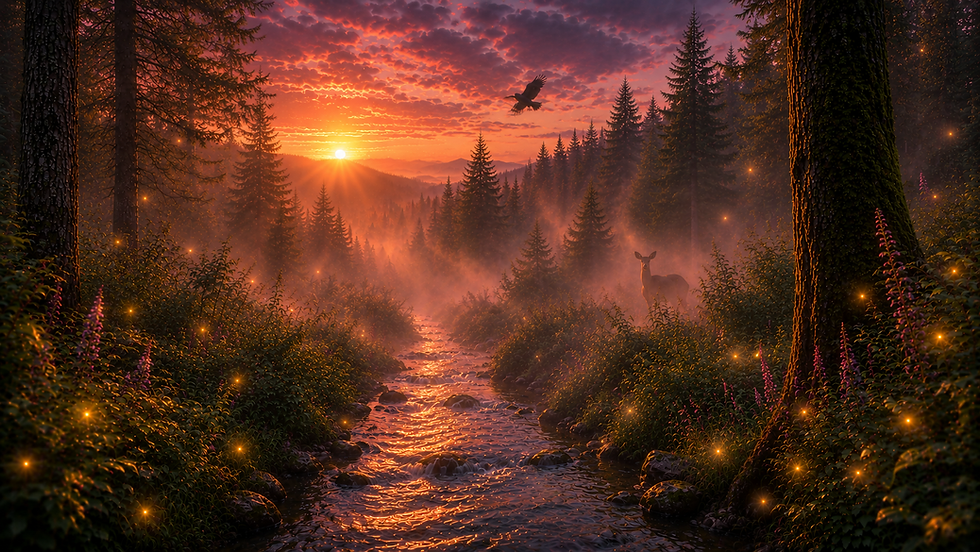
Set against the breathtaking beauty of the Smoky Mountains, Stillwater is a coming-of-age drama about identity, healing, and the search for home. It is the story of a young woman who arrives believing she has no place in the world around her and discovers that sometimes the path to becoming yourself begins by listening—to the land beneath your feet, to the people who love you, and to the quiet voice inside that has been waiting to be heard all along.
Script Excerpts
EXT. MAE’S BARN - NIGHT
Genevieve explores the complex as the cicada drone fades.
She sees a light coming from the barn and peaks in.
She smiles when she sees Cole currying a horse.
GENEVIEVE
Mom said Grannie Mae doesn’t have
a horse.
He looks up and smiles.
COLE
She doesn’t. This is my horse. Do you
like horses?
GENEVIEVE
I’ve always wanted to learn.
COLE
Would you like to pet her?
Genevieve nods and joins him.
Cole gently moves her hand over the horse’s neck.
COLE
Like this, see?
Genevieve suddenly brightens and begins stroking the horse on her own.
He steps back and watches her, as she feels the strength of the horse’s neck and begins to run her hand along the curve of the horse’s back and rump.
COLE
My family owns a stable. You would’ve
passed it on your way up the mountain.
You’re welcome to come by any time.
She starts to smile, then frowns.
GENEVIEVE
That would be nice if I were staying. But
I’m not.
She walks out of the barn, Cole watching her curiously.

EXT. - MAE'S FRONTYARD - DAY
Genevieve keeps crying softly, but then becomes aware of the cicadas. She sits listening. Notices Mae hanging a hammock between two trees. Mae waves her over.
MAE
Get in.
Genevieve balks.
MAE
Go on. Give it a try.
Genevieve reluctantly crawls into the hammock, her face still stained with tears.
Mae gently sways the hammock.
Genevieve looks up through the tips of the trees and begins to relax.
As if remembering, she pulls the carved water spider out of her pocket and starts examining it.
Mae notices.
MAE
You can never be too quick to decide
what something is.
Genevieve sees Mae looking at the wooden spider.
GENEVIEVE
How did the water spider get the fire
across the river to the people?
MAE
She wove a little bowl on her back to
keep the ember dry while she floated
across, and she saved everyone.
Genevieve touches the little bowl carved on the back of the spider.
GENEVIEVE
Hmmmm.
MAE
The water spider wasn’t the strongest or
even the bravest. She was just the one
who kept trying when others had given up.

EXT. WOODS - DAY
Still huffing and puffing, Neve arrives at a large wooded storm-damaged area with flat terrain. Lots of fallen and bent trees.
She sees a patch of gnarled tree roots exposed by erosion, gazes at their immense size.
Shafts of light from the sun illuminate the woods.
She looks up. Through the tree tops, the sun is brighter than before, higher in the sky.
She listens to the wind rustling through the trees, then keeps walking.
She comes to a tree that was struck by lightning, with a long burnt streak across its massive trunk. The top half of the tree is bent like it wants to fall over. Its branches sag.
Neve walks up and touches it, pushes it, but it doesn’t move.
She gazes up in awe.
NEVE
(to tree)
Oh great tree, I can see you’re hurting,
but you refuse to give up.
PAN TREE - as she writes on it with a stone.
NEVE (V.O.)
Your heart is broken, but you keep standing. Your branches are heavy, yet you’re still reaching for the sky. Maybe someday you’ll heal. Maybe you’ll be strong again.
She hugs it.

Themes
-
The land becomes teacher and healer through presence.
-
Nature has the power to transform us.
-
Communities can embrace change without losing their soul.
-
We find ourselves only when we stop letting others define us.
-
Healing begins with coming home to ourselves.
-
Wisdom is found in holding more than one truth.
At its heart, Stillwater is a coming-of-age story about looking beyond the stories that have shaped us and awakening to who we've been all along. Set against a community divided over the future of its land, the story explores what it means to belong - to a place, to a people, and ultimately to oneself.

More than a story about a place, Stillwater is a story about learning to listen—to the land, to one another, and to the truest parts of ourselves.